
Syringa vulgaris L.
Fully-hardy, spreading shrub or small tree, with heart-shaped leaves, to 10cm long, and dense, conical panicles, to 20cm long, of small, single or double, fragrant lilac flowers in spring. To 7m. [RHSE, Hortus, Hilliers’].
Horticultural & Botanical History
‘The common lilac, now so plentiful in every plantation, was a great rarity in the year 1597.’ [Don]. By 1792 Curtis’s Botanical Magazine could comment: ‘Few shrubs are better known in this country than the lilac, few more universally cultivated; there is scarcely a cottage it does not enliven, or a shrubbery it does not beautify.’ blue, white and purple-flowered forms were recorded, the latter with larger flowers. [BM t.183/1792]. Flore des Serres figures a garden form called ‘Dr. Lindley’. [FS f.1481-1482/1859].
History at Camden Park
Listed in all published catalogues [T.951/1843].
Notes
Published Jan 20, 2010 - 05:24 AM | Last updated Jan 20, 2010 - 05:31 AM
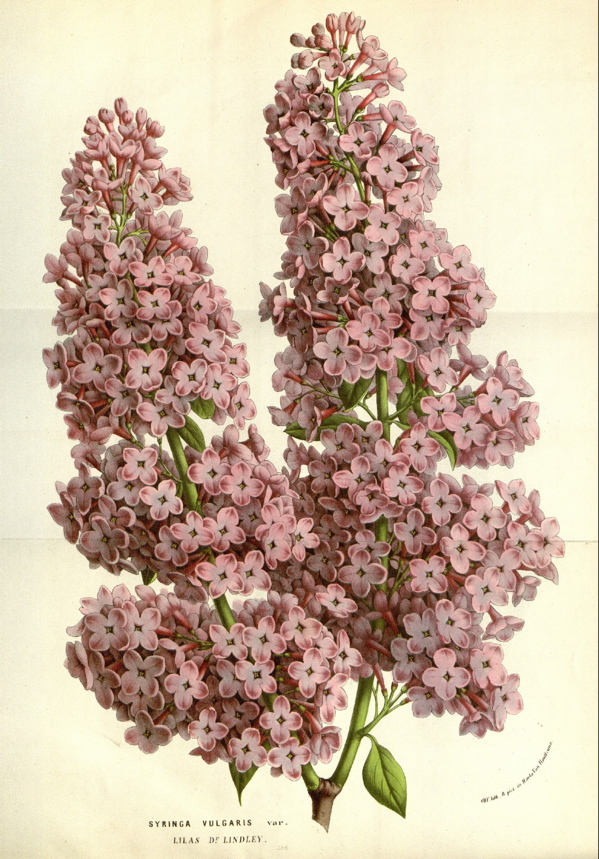
Syringa vulgaris L. ‘Dr. Lindley’ | FS f.1481-1482/1859 | BHL
| Family | Oleaceae |
|---|---|
| Category | |
| Region of origin | Eastern Europe |
| Synonyms |
|
| Common Name | Common lilac |
| Name in the Camden Park Record |
Syringa vulgaris - Common lilac |
| Confidence level | high |
