
Lonicera sempervirens L.
Fully hardy, woody, deciduous or evergreen, twining climber with paired, oval leaves, to 7cm long, and terminal whorls of tubular, rich scarlet-orange flowers, yellowish inside, to 5cm long, in summer and autumn, followed by red berries. To 4m. [RHSE, Hortus].
Horticultural & Botanical History
‘Miller enumerates two varieties; the present plant, which he says is a native of Virginia, and a smaller and much tenderer sort, native of Carolina. The latter rarely if ever occurs in our gardens at the present time; but the former is not uncommon, and if planted in a warm sheltered situation, and trained up a wall, paling, or lattice, is a very desirable plant both for its foliage and flowers, which latter are produced in June and continue in succession till the autumn.’ [BM t.781/1804]. Cultivated by John Tradescant Jnr. in 1656. A number of varieties were figured in Flore des Serres. [FS f.1128, f.1133/1856].
History at Camden Park
Listed in the 1857 catalogue only [T.649/1857].
Notes
Published Jul 08, 2009 - 06:45 AM | Last updated Jul 16, 2010 - 03:59 AM
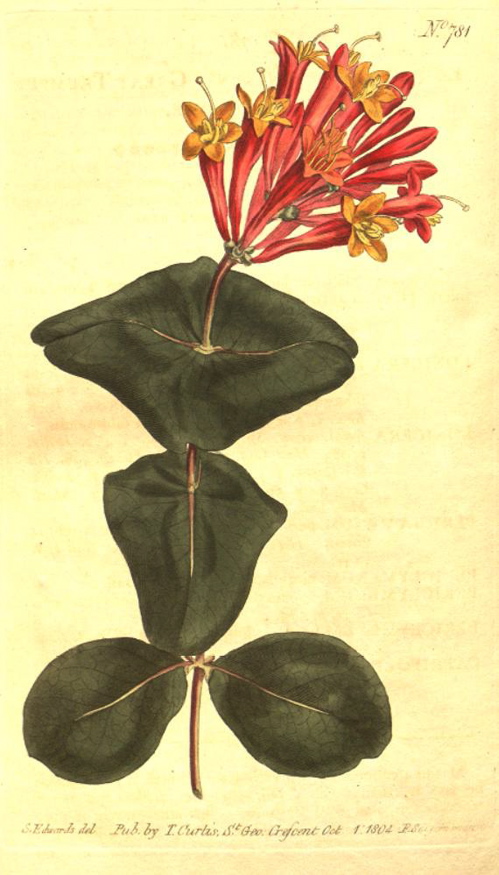
Lonicera sempervirens L. | BM t.781/1804 | BHL
| Family | Caprifoliaceae |
|---|---|
| Category | |
| Region of origin | Eastern USA |
| Synonyms |
|
| Common Name | Coral honeysuckle, Trumpet honeysuckle |
| Name in the Camden Park Record | Lonicera sempervirens (true) |
| Confidence level | high |
